 Loads from YouTube only after you press play
Carbine grip technique: support hand placement and elbow angle
Key points: Carbine grip technique support
- On three USPSA targets at about seven yards, four different holds gave similar times and hits; only the balance-point grip ran all alphas, and Botkin argues technique starts to matter once targets are far, partial, moving or near no-shoots.
- His test: dim the red dot, hold it on a paster at around 18 metres, fire, and watch where the dot moves and settles rather than trying to hit the paster.
- The goal is a dot that lifts toward 12:30 or 1:00 and returns to the original point of aim without dipping below it, which he links to low hits.
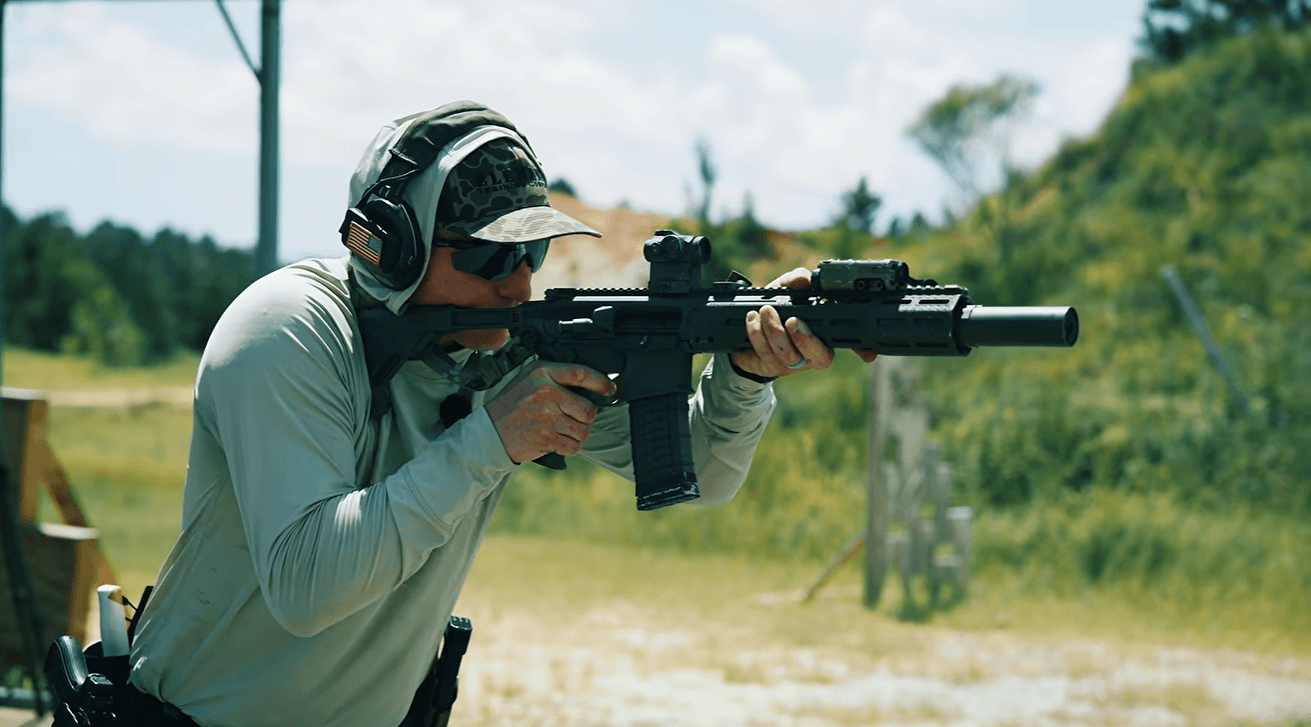
- The support hand sits near the balance point, close to the barrel nut and magazine well, with the elbow tucked under the gun at about the same neutral angle as the firing elbow.
- Bent elbows work as suspension when shooting on the move, whereas a locked-out, stretched hold feels fine up close but leaves nothing to steady the gun while moving.
- Firm rearward pressure keeps the stock from bouncing in the shoulder pocket, and cheek pressure on the stock adds recoil control that wire and PDW-style stocks often lack.
- The same hand position carries over to prone, barricades and pistol transitions, leaves room for light and laser controls on an 11.5-inch carbine, and is why the team no longer runs vertical grips.
About this Tactics and Training video
Carbine grip technique, tested: Lucas Botkin shoots four rifle holds on a three-target USPSA drill at seven yards and finds little difference on close, large targets. He then uses a red dot tracking test on a paster to show why a support hand at the rifle's balance point, elbows at matching neutral angles and a firm stock-to-shoulder connection make the dot rise and return to the same spot. He also explains why his team has dropped vertical grips.
Transcript: Carbine grip technique
Read the excerpt
Over the last couple of years, I have greatly increased the amount [music] of time I've spent shooting rifles. My training ratio historically has been 70% pistol, 30% rifle, and then the 30% for rifles split between precision shooting and carbine shooting depending on what I was doing [music] at that time. But of late, the last year and a half, that ratio has flipped. 70% of my time has been… […]
Full transcript on file — indexed for site search.